
Don't follow leaders
When the truth is found to be lies, and all the joy within you dies

So farewell then Ben Stokes. For diehard England cricket fans, he gave us some of the best memories we’ve had for a very long time. Not just Headingley and Lord’s 2019, but madnesses like Cape Town 2016, Trent Bridge and Rawalpindi 2022 and (despite his injury, for the spirit he baked into the team) Multan 2024. Say whatever you like, the guy was box office: as long as he was still there and fighting, the game was never over.
There’s been a wave of anger for how his career ended, frustration at the selfishness of England’s final innings thrash - and I totally get it. But equally I can understand how Stokes’s burning anger with his bosses left him with the feeling that now was the time to pull down the temple around him.
But even as someone who thinks Stokes was great, I want to write about how he failed, and why his leadership didn’t do what it could have. None of this is a slur on the guy. His Amazon documentary with Sam Mendes shows a commendable honesty about mental health, from someone who it would be easy to dismiss as just a tattooed macho bloke. And as a Worcestershire fan, it’s hard not to get emotional at the story of him messaging the late Josh Baker after marmalising him on the field.
But to explain why Stokes didn’t do all that he could have done, and what that tells us about leadership in general, I want to talk about a couple of other sports.
Start with Michael Jordan. Probably the greatest basketball player of all time, whose personality and will-to-win took the Chicago Bulls to two separate threepeats in the 1990s. But look at his career statistics. Jordan’s average points per game are down the right hand column, and his 6 NBA championship years are highlighted in green on the left.
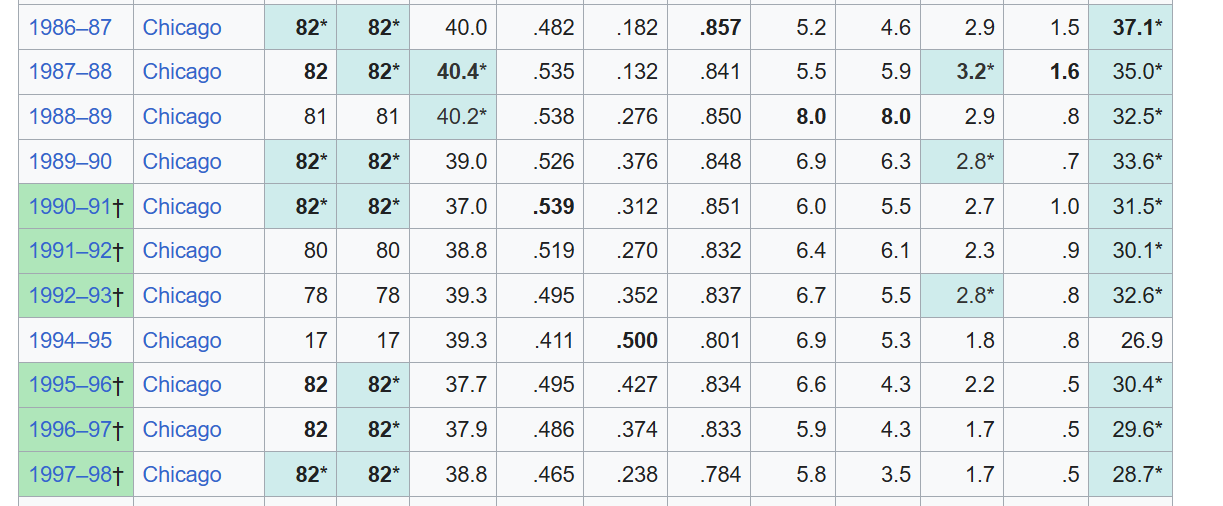
What you’ll notice is that Jordan’s best seasons in terms of personal performance weren’t the years when he was leading his team to the pinnacle of his sport. His best personal totals came when he was trying to carry the team on his shoulders, to do everything by himself.
But it was the promotion of Phil Jackson to head coach in 1989 which really saw the Bulls start to thrive. This was no coincidence. As anyone who has watched The Last Dance on Netflix will know, those early Bulls teams were set up to be “Jordan plus others”, which meant that unscrupulous teams like the Detroit Pistons could stop them with heavy physical contact every time he touched the ball.
It was the arrival of Jackson - and of course the presence of all-time greats like Pippin and Rodman - which made the difference. He persuaded Jordan that he didn’t have to do it all himself. By adopting a new system, Jackson created a way of working where everything didn’t have to come through Jordan.
Of course, he was still a great player, who would step up and carry the team on his shoulders when he had to. But equally, in those winning seasons, Jordan had the trust and the flexibility to sometimes give the title-winning shot to comparative journeymen like John Paxson and Steve Kerr. It was a matter of simple arithmetic: if you put two or three defenders on Jordan, then inevitably someone else had to be free and in space. Jordan had the vision to know that he didn’t always need to take that shot himself: he would succeed just as much if he could find one of his teammates to do that for him.
Back to Stokes, at his best as a leader the same was true. I mentioned the Multan Test, where the values he had instilled (“so what if they scored 550, we’ll score 800”) meant that Brook and Root could thrive when he wasn’t on the field. But as time went on, my feeling is that Stokes increasingly felt that everything had to come through him, and that he retreated into a more narrow idea of leadership.
On that final afternoon at Trent Bridge, on some level it was heroic that he bowled an eleven-over spell. But what does that say about the rest of the team, and about his view of them? If you were a bowler, watching Stokes charge in for the best part of two hours, it would be hard not to believe that you weren’t trusted. If he’s really saying that there’s no-one else in the team that can do a better job after eight, nine, ten overs of fatigue, in my mind that stops being an act of personal courage, and more one of inadvertently undermining his own players.
In the same way, I get the idea that it was worth going out all guns blazing on a cracking pitch to chase down the target. But how did Stokes promoting himself to open despite only having 51 runs in his previous eight Test innings make equally powerful batsmen like Bethell and Brook feel? If you are getting the signal that your own captain thinks nobody else can do it as well as him, then after a while you might start to believe it. I wouldn’t deny Stokes his last chance in the sun, but if he’d come in to bat at 155/3 then that’s the kind of fairytale which might have come true, rather than the meaningless thrash from a mile a way.
As someone who himself took on a leadership role a couple of years ago, I identify completely with Stokes’s tendency to want to lead by example. It’s often terribly tempting to think that I should just do the thing myself, whatever it is. But that’s not real leadership.
The only self-help book I read before I took over was Legacy, about the New Zealand All Blacks, and a key message for me was that leading teams isn’t just about the here and now. It’s about recognising that you are only a small part of the longer history of an organisation, about recognising and celebrating that heritage, and about creating structures where people can thrive after you are gone. And there I feel Stokes has demonstrably failed. Who comes after him as captain? Root again? Brook, seriously? Who else? While Stokes was leading, part of his job was to find potential successors, to build their experience and confidence, and to arrange a proper handover.
Of course, Jordan didn’t manage that either: Chicago still haven’t won an NBA title without him, even nearly thirty years on. But I think this way of thinking about success, about the difference between stardom and team spirit, is a really valuable one.
As we look at the World Cup, it’s still hard to know what will happen, but it’s hard to bet against France. But really, the success of the French team is the success of a system. If you look at the back-to-back European Cup winning Paris St Germain teams, it’s hard not to spot the common thread.
Those attacking forwards Doué, Dembélé and Barcola are playing the same kind of system for France as they do for PSG. And it’s precisely because that system works so well that it’s possible for players like Mbappé and Olise to slot in for France, taking over the roles played by people like Kvaratskhelia and Neves for PSG. It doesn’t matter who it is: if you stop one attacker, someone else will pop up and have a go.
And more than that, it’s impossible not to notice that PSG only became truly great when Mbappé left. After their futile attempts to buy their way to success by throwing money at galacticos like him, Messi and Neymar, the elusive Champions League wins only came when they adopted the collective, picked attackers with talent who would also sometimes defend, who would subjugate their own talent for the good of the team.
I hate to make predictions, but this is why I think France are likely to go further at the World Cup than Portugal, who are still playing the star system where everything comes through an ageing Cristiano Ronaldo rather than trusting the collective quality of their squad.
And I think wherever you are, if you are in any kind of leadership role then it’s worth reflecting on these stories of Stokes and Jordan, and thinking about what building a successful team really looks like. Enjoy the last 16 and the quarterfinals!
No reference to parking meters. Curious about the mix between Dylan and the Jefferson Airplane in the headline.
'Mission Command', how SF units operate as opposed to Green Army units. I had a small team of very experienced guys [civilian] and found the impulse to spend my days with my feet on the desk while they achieved 'the mission' between themselves, bespoke to their sector/personalities etc. with just minimal prompting on general direction. Upstream it was standard hierarchical, they'd always mess things up by a. forgetting what they are trying to do [most common human stupidity, © Nietzsche] and b. getting executively involved in things they weren't au fait with in trying to build perception they are 'a leader'.
Anyway, the pump don't work 'cos the vandals took the handles.