
The Searchers
But I still haven't found what I'm looking for

As we trundle through the first half of the twenty-first century, there’s some kind of grim satisfaction in ticking off the years when classic pieces of sci-fi were set. 2019 has been and gone, and while Boris prorogued Parliament and won his majority, we didn’t see the events of Blade Runner take place. In 2022 we were blindsided by the Ukraine war and Liz Truss, but at least we weren’t all eating Soylent Green. And for all that Sarah Connor warned us, 29th August 1997 saw the founding of Netflix not Judgment Day - though there’s still time for the “Future War” part of that film to be taking place in 2029.
But generally speaking, when sci-fi predictions are wrong, it’s because they over-estimate the rate of technological progress. As the saying goes, where are our flying cars and moon bases?
However, there’s at least one example where a giant of the genre drastically underestimated the rate of progress. In his 2001 Odyssey series, Arthur C, Clarke was right about the geostationary satellites, but mankind wasn’t heading to the outer planets by the turn of the millennium. However, Clarke erred in the direction of extreme pessimism concerning the capabilities of search algorithms. In 2061 Odyssey Three he describes the centenarian Heywood Floyd trying to recall the source of a line of poetry:
‘I too take leave of all I ever had...’
From what depths of memory had that line come swimming up to the surface? Heywood Floyd closed his eyes, and tried to focus on the past. It was certainly from a poem - and he had hardly read a line of poetry since leaving college. And little enough then, except during a short English Appreciation Seminar.
With no further clues, it might take the station computer quite a while - perhaps as much as ten minutes - to locate the line in the whole body of English literature. But that would be cheating (not to mention expensive) and Floyd preferred to accept the intellectual challenge.
The emphasis is mine, but of course it’s laughable to think that by 2061 that kind of search would take so long and you’d worry about the cost of it. Clarke could predict a lot, but he missed the idea and the power of Google’s PageRank algorithm. It’s maybe not surprising - he was writing in 1987 after all, and even some techno-savvy people didn’t see the significance straight away. There’s a hilarious snark in Michael Lewis’s The New New Thing (published in 2000) where he sneers at even the name of the company, let alone the valuation:
With companies called Google going for $75 million, Clark did not see much point in selling air: everyone else was already doing that
Google’s market capitalization is now $4.6 trillion, meaning that it has grown 60,000-fold since that valuation, or an average of 50 per cent annual growth for the last 26 years. And of course, there’s more to that growth than just web search. But still, I think it’s reasonable to argue that the ability to efficiently find things on the Internet is what turned it from a jumbled pile of resources, or one where a directory of acceptable sites could be curated like a phone book by Yahoo!, into the dynamic and valuable ecosystem it became.
There aren’t many companies whose names become verbs, but Google is rightly one. Their brand is finding information, they represent trust. Search is a solved problem. Or rather, it was.
In recent months, Google has started to replace their classic list of ten prioritized documents - and how often did you even have to go onto page two of that list!? - with an “AI overview”, which isn’t always so good.
To be fair, if I give it Heywood Floyd's line of poetry, both the classic search and the AI overview correctly identify it as coming from Farewell by Robert Nichols. But other searches don’t work so well. As I pointed out on Twitter, when I asked it for help with my last clue on Saturday’s Times Cryptic Crossword, Google pointed me at an entirely different text:
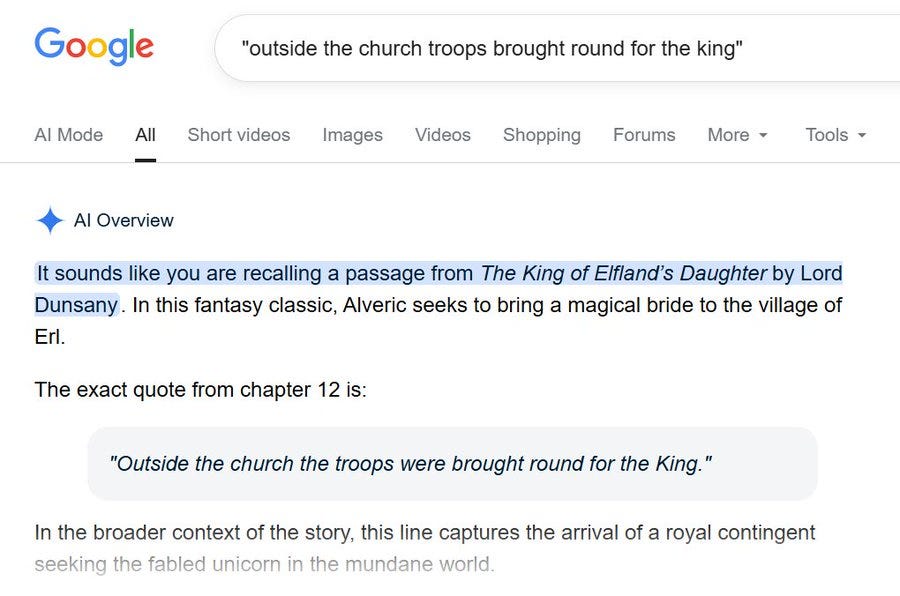
But that quotation is entirely fictitious! The text of that book is available for free on Project Gutenberg, and that quote is nowhere to be seen (the words “troops” and “church” aren’t used). It’s a bang-up AI hallucination, front and centre.
It’s an astonishing exercise in trashing one’s own brand: a company which was a byword for accuracy and reliability, deliberately releasing an inferior product to jump on the AI bandwagon.
I’m absolutely not a Luddite when it comes to AI. I’ve perhaps been a bit pessimistic about its capabilities in things I’ve written here, but I don’t know any mathematician who wasn’t blown away by OpenAI’s recent disproof of the unit distance conjecture, and what it means for human and machine capabilities.
But still, LLMs remain a technology based around predicting likely outcomes. Hallucinations seem very hard to get rid of. And if AI is going to become as important as its boosters predict, then I think it’s going to be vital to think carefully about use cases and guard rails, to decide when accuracy matters (medical diagnosis and legal contracts perhaps) and when vibes are enough (generating funny videos).
Of course, other search engines are available, so don’t bother recommending your favourite. But still, as a fan of the Google infrastructure, I hope that this very public enshittification of their flagship product is enough to make them think twice about blindly rolling out AI into my gmail and my calendar, though I’m not holding out hope. Otherwise Clarke’s central prophecy of a computer blindly making decisions impervious to reason and over-riding human preferences might end up being far more accurate than we might like.
Google Search was getting (even) more frustrating before the AI hearsay section.
It seems to prefer suggesting videos to easily-consumed information, ranking them higher (and also including TikTok, X and Facebook video sources, for god’s sake). Why?
And it’s almost impossible to ask it for the *latest* information on something. The News tab can be wildly outdated (by months or years), and the only other way is:
> Swipe/mouse over to the “Search Tools” option and tap
> Select “Any Time”
> Choose from either “Past hour”, “Past 24 hours”, “Past week”, etc. None of these give you the *latest* results.
No wonder people get their news from social media…
Not to screw up your comments section, but I personally *do* need a recommendation for a working search engine.. Google has become just absolutely, bizarrely shit. As you say, it feels like the results are just vibes now -- it might work if you don't actually know what it is you want to find (if you're just asking an impressionistic question), but if you know exactly what you want it is INCREDIBLY bad at finding it. Sorry. I know I'm just restating points you've already made. Just makes me so cross. What exactly is their underpants theory here?