World in Motion
What you're looking at is the master plan

There are some “maths in the news” stories which keep popping up from hibernation like cicadas. Once every couple of years there’s a football World Cup or European Championship, and some academic will get rung up by their university press office and asked to talk about collecting Panini stickers.
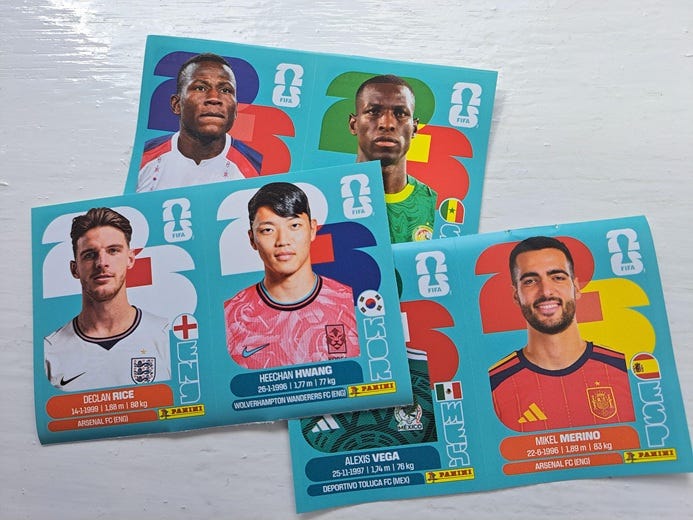
And so, as a public service, I’m happy to give you that conversation now for free. I’ll tell you the basic argument that I’d give the press office, and as a bonus I’ll tell you three reasons why it’s wrong.
Usually the conversations are framed around the cost of buying a full set of stickers. As tournaments expand, so does the number of stickers. The Guardian has already gloomily run the numbers and told us that to collect all 980 stickers (7 stickers per packet, each packet costing £1.25) might cost £1000.
Naively, this seems wrong: to buy 980 stickers would be 140 packets, so at that price we’d be looking at a £175 outlay. But of course we know that won’t be right: in theory we could get incredibly lucky and buy 980 different stickers straight off the bat like this, but it’s overwhelmingly likely that we won’t. And that’s where a bit of maths comes in.
Waiting for the inevitable shutout that never comes
We can think in general about how long we have to wait for good things to happen. Suppose we keep trying an independent experiment at random until we get lucky: how long do we have to wait?
Well, obviously it depends on the chances of success. But if you had to guess how long on average it would take to toss a head, with chances of success each time 1/2, you might guess 2 tosses. If you had to guess how long before you roll a six, with chances of success 1/6, somehow 6 rolls feels right. And the nice thing is, that’s exactly right!
I can even prove it to you now. Suppose we are waiting for a good thing which happens with some probability p. If we write E for the number of tries we expect it to take, there’s a simple argument which links p and E. We can consider our value E, based on thinking about the first try. Maybe we succeed, which happens p of the time, in which case we waited one try and we’re done. More likely, we didn’t succeed - this happens 1-p of the time. In this case, it’s cost us one try, but we’re no closer to success, so on average we’re going to have to wait an extra E turns to succeed on top of that.
In other words, there’s an equation that our numbers satisfy:
If you rearrange that, you’ll get that p times E is 1, or that E is 1/p, and that’s all you need to know to become an expert on Panini sticker counting!
We can think of looking at stickers one by one. As our collection builds, it gets harder and harder to find a new sticker, reflected in the fact that p goes down each time. When we need k stickers out of n, the chance that the next sticker we open is a new one is exactly k/n, so on average we’ll wait n/k goes.
And you can see how this works: right at the beginning, k is close to n, so we’ll probably get a new sticker nearly every time. But things get really hard at the end. When we’re looking for the last sticker k equals 1, so on average we’ll have to buy n more stickers just to complete the set. We’ve seen that doing that would cost £175, and the penultimate sticker costs £87.50, the one before that £58.33 and so on.
You can see how it adds up fast, and how we could plausibly get to a number of the order of the Guardian’s £1000. Indeed, with a bit more maths, I could tell you that the total cost will be n times the “harmonic number”, which looks a lot like the logarithm (yay!) of n. In other words, to fill a sticker album of n stickers will take n log n different stickers - that’s a lot!
We're gonna score one more than you
Normally at this point under the strict rules of the National Union of Maths Communicators, I would stop writing and hand back to the press office. However, I want to mention three real-world reasons why this calculation in the Guardian is wrong.
Firstly, and most obviously, we don’t have to keep waiting for the final stickers. We can cheat! We can go to the Panini website and simply buy the ones we need. It will cost you 45p per sticker rather than the 18p or so to buy them in a packet, and you can only get the last 50 that way. But it puts a hard cap on how much it will cost: getting these last 50 stickers will only take £22.50, and we’ve seen that’s where the vast majority of the cost would otherwise be. (On average it would cost about £790 to collect these last 50 by the traditional method, so it’s a huge saving)
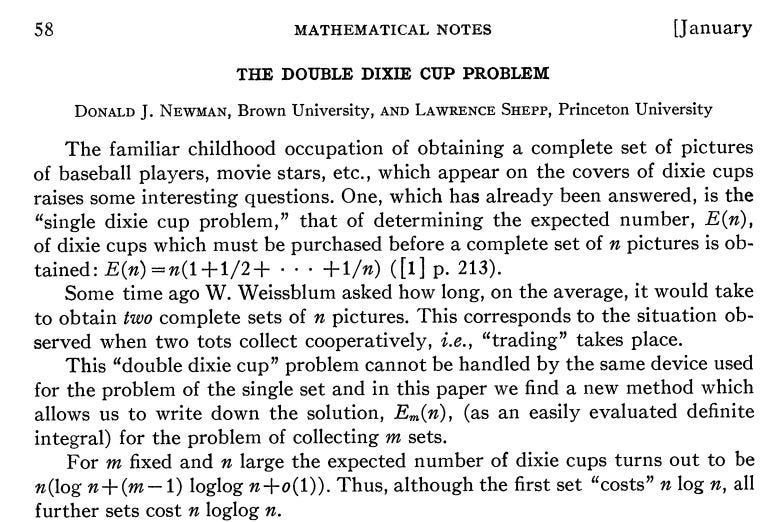
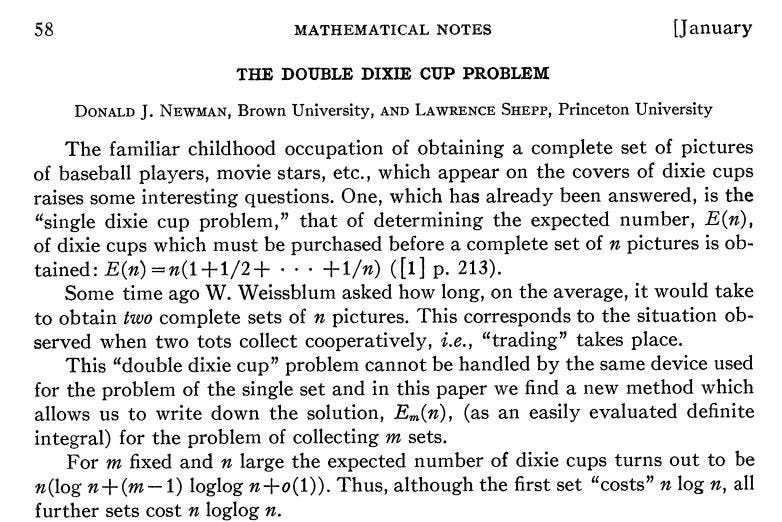
Maybe that doesn’t seem in the spirit of the thing though. Certainly buying loose stickers off the website wasn’t an option in the 1980s playground, and so maybe we need to stick to the rules of need-need-got which applied there, and swap with friends. The mathematical analysis gets more complicated, but it was done by Newman and Shepp as far back as 1960. They quantified the benefit of sharing with friends: essentially completing two whole sets isn’t twice as hard as completing one, because you build up duplicates as you go through the first set. The more friends you are swapping with, the more that the overhead of completing that first set is diluted among the group.
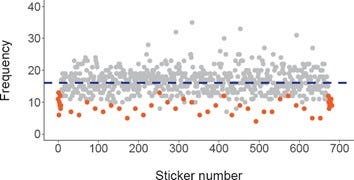
A final cautionary point though: all this analysis is based on the idea that all of the stickers exist in equal quantities. Panini promise that this is true, but a statistical analysis in Significance magazine indicates that the shiny stickers may be rarer, for example. And if stickers aren’t equally likely to be found, the problem gets harder, both to analyse and to succeed. But in theory you could be waiting even longer to pick up that final rare one, without cheating or swapping.
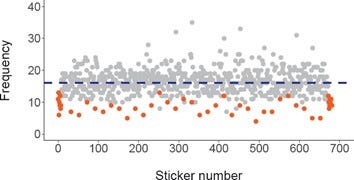
I hope this doesn’t put you off collecting, or from enjoying the World Cup. And more importantly, if anyone needs a Declan Rice or a Mikel Merino then please just let me know.