
Zero tolerance
It's a gas, gas, gas

I know I last posted on Saturday morning, so every social media audience-building how-to guide would be screaming at me not to post now. But on the basis that I’d rather only write when I have something interesting to say, here’s a brief vignette about how Net Zero and AI are pulling in opposite directions.
I previously wrote about this in quite general terms by discussing hypothetical exponential growth, but now I want to put flesh on the bones by looking at one particular planning decision, and how it illustrates the pressures we are under. I’m worried that there’s a potential Tragedy of the Commons at work, not helped by a simple mathematical error. Let me explain.
Today’s Times reports on plans for a 1 gigawatt data centre in North Lincolnshire, and compares its carbon output to that of all British Airways flights. Since I’m generally suspicious of these kinds of comparisons, particularly when it comes to AI, I thought I would take a look at the planning documents (yes, I know I’m a nerd!) and see what they say. What I found shocked me.
In a Carbon Footprint Statement, there is an analysis of the likely Stage 2 emissions (running the data centre itself, not building it or travelling to it), which concludes that each year the project will generate around a million tonnes of CO2 equivalent at its peak, which they claim is only 0.1% of the UK’s 2035 Carbon Budget.

This is justified by Table 1 of the report, which claims that the UK’s annual carbon budget for 2035 is 965 million tonnes:

But this is simply wrong! Indeed, even a mathematician with no expertise in anything other than numbercrunching can tell it is wrong (we currently emit of the order of 400 million tonnes a year). A quick check of the Government website tells me that 965 million tonnes is the total figure for 2033-2037, if we are to reach Net Zero on the agreed pathway.

The energy consultants who prepared the report are out by a factor of five! Our annual budget is actually 193 million tonnes, and so this data centre will be using just over 0.5% of that, not 0.1%.
Still, maybe that’s not so terrible? 0.5% still doesn’t seem like a huge amount. But that’s where the Tragedy of the Commons comes in. This is one data centre, the impact of which is being assessed by one local council based on one report. But nationally, we know that very many bids are going in for data centres all over the country. The same Times report tells us:
about 140 data centres have asked regulators for a connection to the national electricity grid. If all were built, they would require more electricity capacity (50 gigawatts) than Britain’s peak demand on a February day (45GW).
So if a single gigawatt data centre uses 0.5% of our carbon budget, we might extrapolate to say that all these data centres together would use something like 25% of our 2035 Carbon Budget. That’s a lot! It was already going to be tough to fit all our heating and cooking, lighting and travel needs into the UK’s self-imposed Carbon Budget. But adding this many new data centres to the mix is going to make it significantly harder.
In fact, it’s worse than that. The (corrected) calculation in the environmental report that 1 gigawatt would represent 0.5% of our carbon budget is based on an assumption that the carbon intensity (CO2 emitted per kilowatt hour) of our power mix will fall by about a third between 2025 and 2035 (from 177g/kWh to 115).
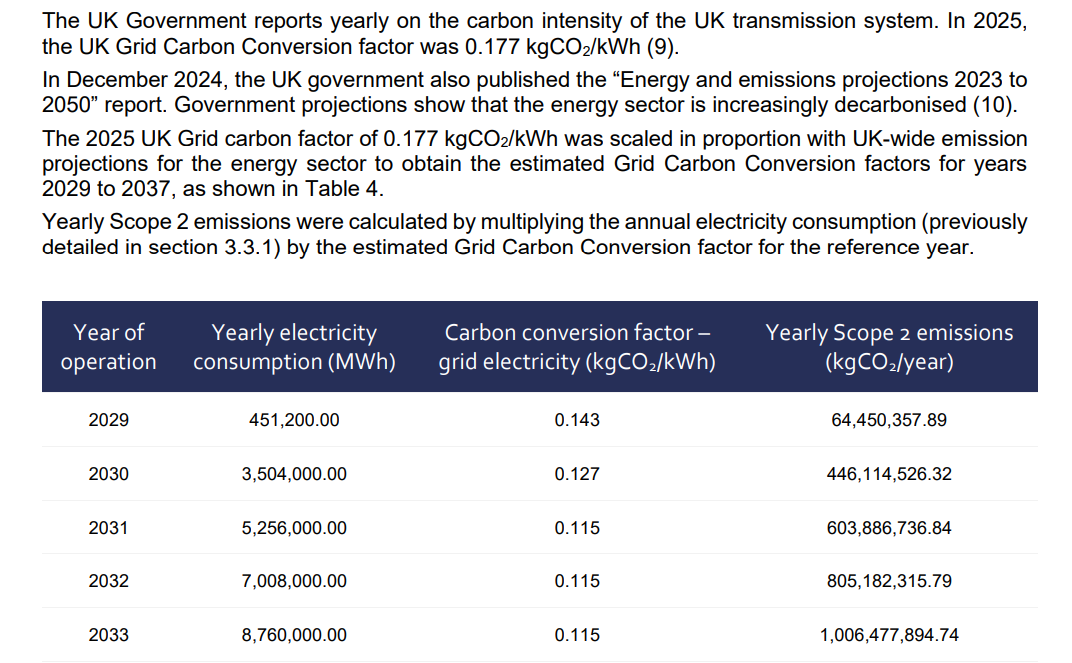
But that projection feels very static to me. That is, it assumes we will build out renewables at the anticipated rate, get them connected to the grid and so on, and is presumably based on a scenario where our power demands don’t increase significantly.
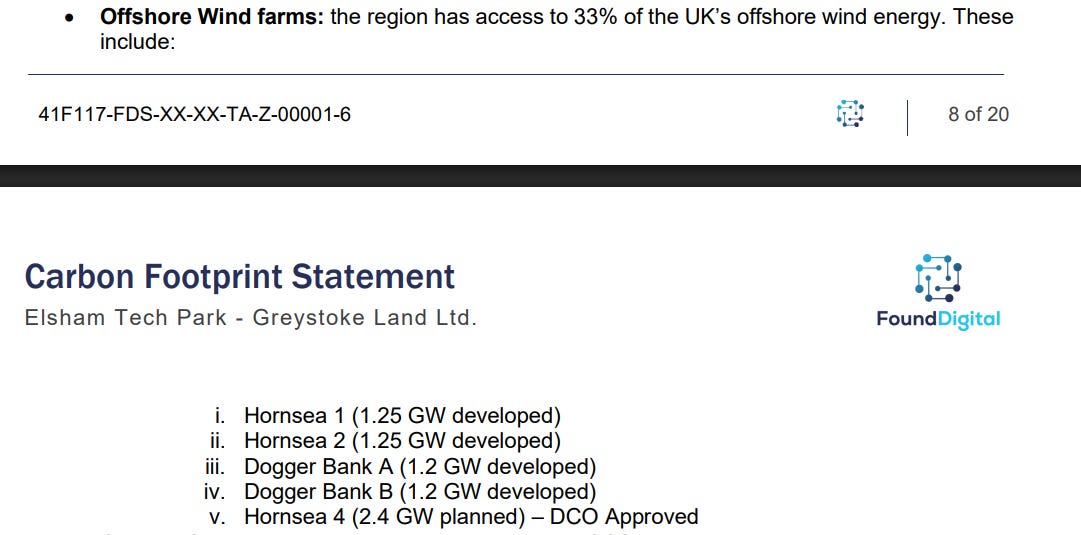
Whereas, if we’re going to be hooking 50GW of power demand to the grid, that doesn’t really feel such a comfortable assumption any more. All these new data centres are going to be competing for the same fluffy offshore wind sources mentioned in the Lincolnshire report:
Worse, all this demand is going to be 24/7. Running a data centre isn’t the kind of job where you can take long lunchbreaks and weekends off. As a result this new demand is going to make the pressure on non-renewable sources even more intense during the periods where the wind doesn’t blow and the sun doesn’t shine. (And trust me, I’ve visited that part of North Lincolnshire a lot, and nobody would ever mistake it for the Costa del Sol).
It’s hard to know exactly what effect this would have on the UK’s overall energy mix, but as a sort of worst-case scenario, if our carbon intensity didn’t fall at all then the 25% of Carbon Budget we were guesstimating might scale up to just short of 40%. That’s a lot!
Of course, this is all back-of-the-envelope stuff. But the 0.1% vs 0.5% error in the report produced by Actual Environmental Consultants doesn’t exactly give you confidence in the quality of the envelopes where these things are being calculated.
At the very least it seems reasonable to ask whether a Government which claims to want the UK to be both a leader in AI and a pioneer in Net Zero and grid decarbonisation is going to have to pick one or the other.
The word for countries that don't have lots of energy to use is "poor". That is the choice successive governments are making for us. It's not just AI, it's everything.
The tragedy of the commons is a global one.
While we myopically build carbon budgets within our borders, data centres will simply be built in other jurisdictions. Global emissions will likely end up higher, but our politicians will proclaim our virtue and we will all end up poorer and more dependant on foreign regimes for our future economic development.