
Water torture
Why are we always on the wrong side

The Guardian were wrong about AI data centres again this week. On some level it’s hardly worth mentioning, but I have a grim fascination with watching zombie factoids propagating, so I wanted to record it here.
On Thursday, they wrote the following:
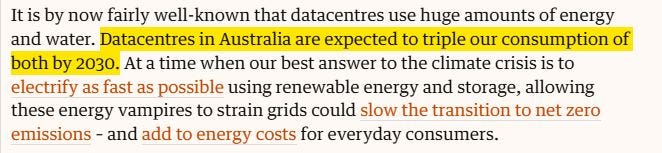
"It is by now fairly well-known that datacentres use huge amounts of energy and water. Datacentres in Australia are expected to triple our consumption of both by 2030”
Huge, as the kids say, if true. Tripling our consumption of water would be an enormous deal. It would mean that two-thirds of all our water usage was going to data centres, that twice as much water as we currently use in total would be going to them alone.
But of course, it’s nonsense. If you follow the link in the article, it shows you that the correct statement is that data centres will triple their consumption - their, not our. They will go from 5.5 billion litres, or gigalitres, of water in 2025 to 17 gigalitres in 2030.
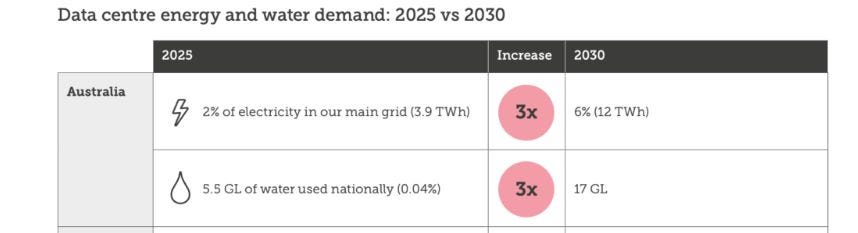
That sounds a lot, until you look at the percentage figure, and look up total Australian water usage. These guys get through 17 thousand gigalitres a year! In other words, data centres are going from about 0.035% of water usage to about 0.1%. It’s nothing like as dramatic.
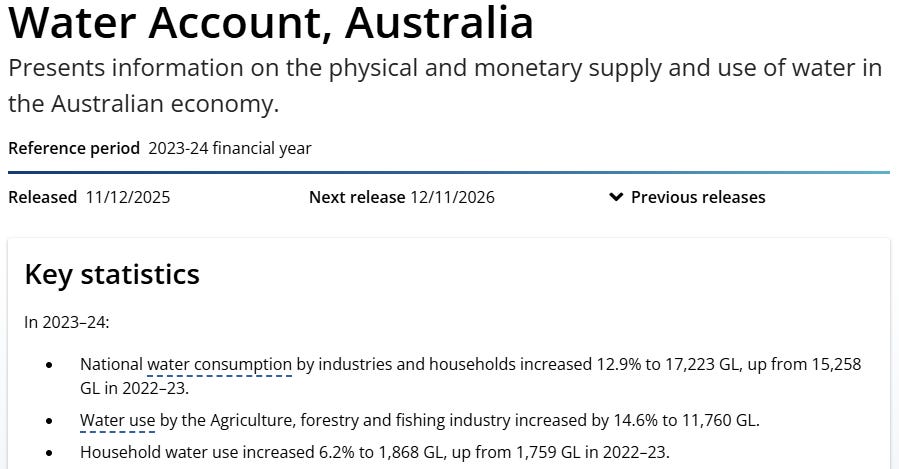
It took me less than 5 minutes to figure this out and to post on Twitter. It took me about as long to write to the Guardian Reader’s Editor - and the piece is now corrected:

But really I think what matters here is not one individual mistake in one individual paper, it’s what tells us about how the media and popular debate operates. As I wrote back in December, it’s never been easier to do this kind of elementary fact checking. The sources I posted here are not obscure - one of them was even linked in the article itself.
But why did I take the time to do the fact checking? Why did I even click on the article itself? I happen to know from the work of people like Andy Masley that there’s a huge amount of misinformation about AI and water, and I’d written a debunking piece about one such factoid last autumn. So on some level, I have a grim fascination with whether people will get it right - I’ve taken the time to do some basic reading and thinking about units and numbers, and am primed to look for the problem.
Maybe this makes me a nerd and a pedant. Honestly I’m not proud. I do have concerns about AI, about its energy use and about copyright, but it absolutely enrages me to see lazy writers just tapping into the “It is by now fairly well-known that” way of thinking that the article exhibited.
As I say, the idea that total water usage would treble is ludicrous. And yet whoever wrote the article didn’t have the internal sense checking mechanism to stop and ponder at the words they were putting on the page. I know newspapers are cut to the bone these days but still some sub-editor, presumably with some degree of literacy, read those words and didn’t stop to think “hang on, really?” before publishing the piece.
On some level, I think the reason for this is just laziness. If you are in the fashionable mindset that AI is bad in every way then you are prepared to take any tropes or numbers that reinforce that on trust. It’s a huge degree of confirmation bias. But if you’ve outsourced your thinking on that issue to such a great extent, what else are you wrong about for the same reason?
As I’ve written before, there was a time when vaccine scepticism was fashionable on the left. People just seemed happy to assume that energy storage solutions will come along to decarbonise the UK grid by 2030, without bothering to scrutinise that claim before heading to the polling booths. Are there other things where the fashionable opinion is also equally wrong?
At the very least, I don’t think the reporting of the AI water issue is a trivial matter. Perhaps that one piece was an honest mistake by a journalist. But a good litmus test in these kinds of situations is to look which way the mistakes go. If reporting was just inaccurate, then there’d be as many pieces wildly understating water use as there were wildly overstating it. Whereas as Masley keeps pointing out, the media errors only ever seem to go one way - that’s not sloppiness, that’s using dubious data as a way to reinforce your own prejudices.1
I know I write a lot of pieces on this Substack which are just “data in media bad, surely we can do better”, and this is another one of them. But I do genuinely believe it. However, I think the first step towards getting better is to admit that there is a problem. And at a time when it’s incredibly fashionable for the media to worry about misinformation, it’s ironic that on this occasion the call is coming from inside the house.
I hope you enjoyed the dash followed by the “it’s not X, it’s Y” trope, just to annoy the AI detectors. Entirely hand-written I assure you
For most of my career - notably the civil service - I've worked in organisations dominated by arts graduates. I've noticed some (not all) have a form of numbers blindness: they may be very smart, but they assess things purely on the cogency and logic of the prose argument.
They genuinely don't find a stat-filled piece such as you or Neil O'Brien might write compelling, they don't understand why someone would be unconvinced by a well-argued piece without any facts (it would convince them!) and when you do tell them to use stats, they throw them in at random, like a colour-blind person asked to decorate a cake.
As we retreat to the emotional safety of our social media silos, "fashionable opinion" becomes more based on what Stephen Colbert called (satirically) Truthiness: stuff that *feels true* based on our gut intuition or desire, rather than on facts, evidence, or logic...