
Barber slop quartet
Almost cut my hair, it happened just the other day

I seem to spend a lot of time on this Substack pointing out errors made by left-coded groups, whether about AI water usage, renewable energy or the BBC’s version of history. Maybe that’s just because I’m incorrigibly right wing. I don’t think I am though, I like to think it’s more subtle than that. I think that because the majority of scientists and bloggers lean left, a lot more people will pick up mistakes by right-coded groups and so I’m adding less value by doing so. Further, I think there’s a worryingly tribal element to some of it: too many people on the left won’t call out mistakes from their team, and so it’s left to the likes of me to do it.
On the other hand, of course there’s no harm in wading in from the opposite direction at the right time. I did it when I talked about concerning levels of anti-vax in Reform or attacking Rachel Reeves’ tax changes from the left for example, and it feels like it might be time to do it again if only to keep up my centrist credentials.
Like all the best arguments, it started on Twitter, when Hugo Gye posted the following graph from the FT and people went nuts:
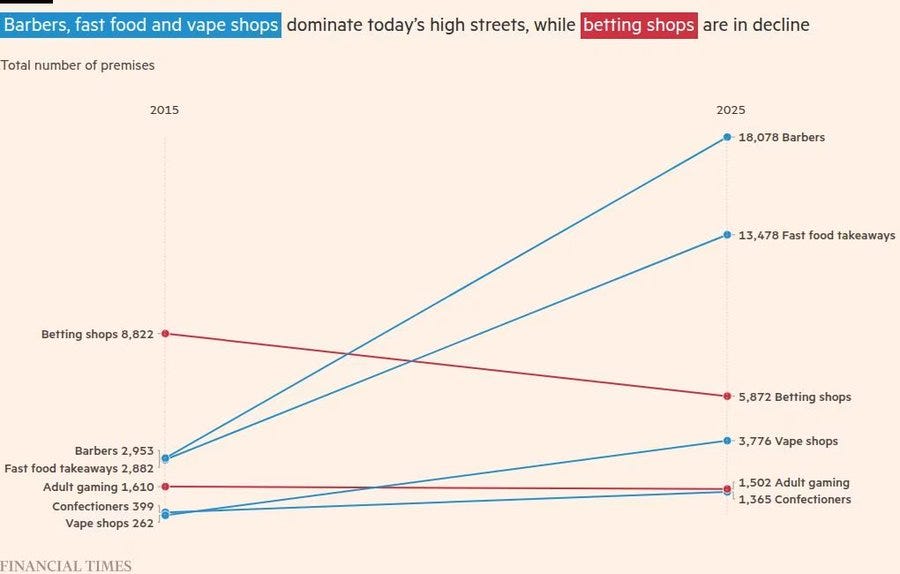
The number of barbershops had increased sixfold in 10 years! That’s insane! We’ve all heard stories about fraudulent barbershops being used as a front for money laundering, and this shows us the scale of the problem. There’s no reason for a genuine sixfold increase, it implies maybe 80% of barbers’ premises must be fraudulent.
Except I wasn’t convinced. I pulled out my Fermi estimation toolkit to suggest that 18,000 barbershops didn’t seem like an unreasonable number for a country of this size:
If I was going to Fermi estimate this, I'm not sure 18,000 barber shops is a crazy number. UK population is ~70 million, half of those are blokes, so that's about 2,000 men per barber shop. If everyone gets a haircut every couple of months that's about 40 haircuts/work day
My account is locked for a quiet life these days, but Tom Harwood cut and pasted it (thankfully anonymously), attracting a whole bunch of replies saying “OK, but why have the numbers gone up by a factor of six then, I don’t remember a shortage ten years ago?”.
It’s a reasonable question of course. A factor of six increase is very dramatic indeed. In fact, it’s so dramatic that I suspect that there’s a measurement error involved, and that the quoted 2015 figure can’t have been accurate.
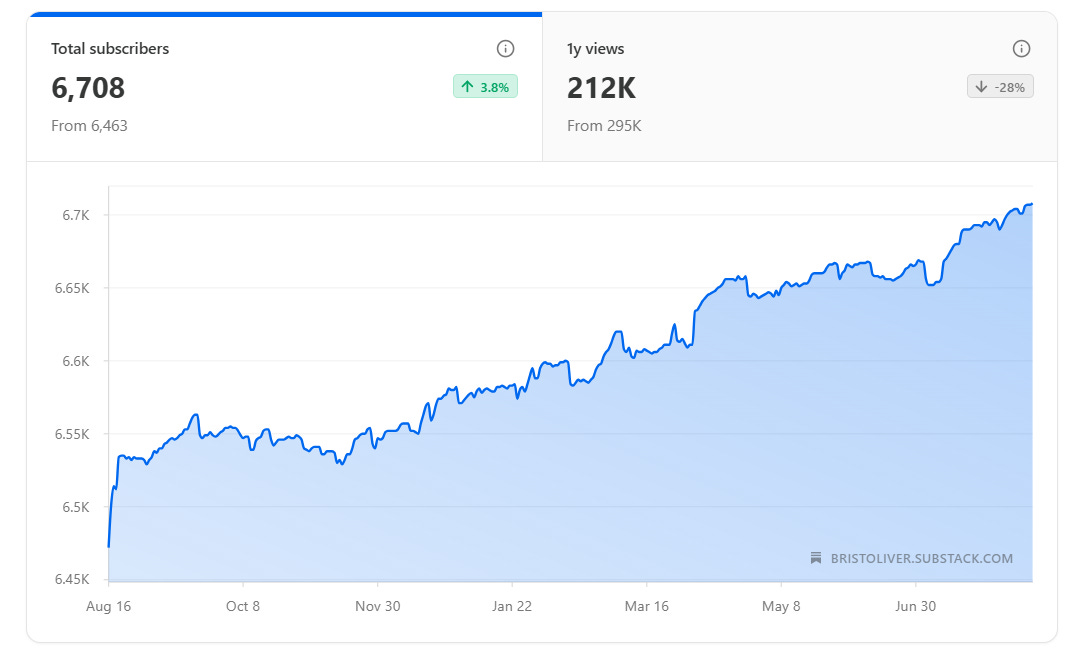
On some level, I base that on gut feeling: it just feels like too big an effect. Sixfold growth represents a 20% annual increase compounded for a decade. Even a runaway successful business like Greggs took 25 years (from 1994 to 2019) to go from 1,000 shops to 2,000, which is more like a 3% annual increase. That’s the kind of growth I’ve been seeing on Substack subscribers lately, and it feels like how things tend to change in a kind of mature phase of well established entities.
To be fair, McDonald’s did achieve a more impressive growth rate (from 100 branches in 1959 to 1000 in 1968), but there’s a deeper point. We’re not interested in pure exponential growth - it’s more like the COVID variant model of hidden exponential growth. It’s not enough to track the growth of all barbershops, we only care about dodgy ones: presumably those have gone from almost nothing to 15,000 in a decade, which implies faster growth still.
However, Greggs and McDonald’s are legitimate businesses, constrained by rules on taxes and planning. Perhaps the barbershops aren’t constrained in the same way, and we can’t make an argument based on growth rates alone. Whatever case we try to make can always be undermined by the Super Hans Principle:

If we don’t believe there were only 3,000 barbershops in 2015, maybe we can try to check that another way? COVID Twitter Legend Alex Selby resorted to history. He found a 2005 Cambridge Yellow Pages which had 20 barbershops in. As he points out if Cambridge has about 1 in 500 of the total population that implies that the true figure might be about 10,000 (scaling up and assuming a constant number of barbers per capita).
That feels more plausible. And it’s backed up by another data point, an Observer piece from earlier in the year reporting on the same story, which tells us that:
Between 2018 and 2025, barber shop numbers rose by 50%, to 18,411. More than 750 new barbers opened in 2024 alone. In some areas they throng the streets in quite astonishing numbers. For example in Rochdale, a town with a population of less than 250,00 people in Greater Manchester, there are 90 of them in operation. In Porth, a former mining town in Wales with just 5,600 residents, there are six, which sit amid boarded-up shop fronts to either side.
That’s a lot more plausible. If there’d been a 50% increase in barbershops, that implies the number in 2018 was about 12,000, which seems like a more reasonable number and is consistent with Alex’s extrapolations. It casts severe doubt on the 3,000 figure though: do we really believe that there was a wild fourfold increase in 3 years (from 2015 to 2018) followed by a sudden slowdown, when all the messages are that the problem has got worse lately?
And that growth rate seems more plausible: it’s a 6% annual growth, which is probably in the right range of “suspiciously successful” (particularly given the clustering effects identified in the Observer article), but not so suspicious as to trigger alarm bells on the Fermi principle alone. The Fermi calculation is never going to be an exact one, and if 18,000 wasn’t a suspicious number then nor would 12,000 have been. In general, official statistics can be hard to interpret - just what is a barbershop and how is that coded? As other examples in the thread showed, these kinds of categorisations can be tricky - if the interpretation of labels changes, then you can see a bigger effect than the true one.
So really, I've managed to achieve centrism once more. I believe there’s an issue, particularly in certain areas. But I don’t believe the purported sixfold increase, even if I fear that claim will continue to reverberate around certain corners of the Internet as a zombie statistic far into the future.
If nothing else, it feels like I’m sticking close to my Logging the World roots of not taking things at face value if they feel implausible, and kicking the tyres on numbers whether they come from the left or the right. And that’s not a bad place to be.
Have a good week!
The other variable is the level of men's grooming. I see people who look like they have perfectly good haircuts going in for very small trims all the time whereas the once every six weeks is now abnormal
As some who does occasional research on the history of consumption and retail as well as modern patterns looking at directory/ telephone data is a great way to do things. But it is also important to add that as incomes have risen so the frequency of having ‘our hair’ and nails done may well have increased and having your hair cut become more of an event. Additionally some male hairdressers have moved to on line bookings over walk-ins and this may have spread customers more. My hairdresser has 15 minute slots but he tells me it can take him 5 to 30 minutes to cut hair depending on whether the shop is full or empty. So with walk ins and a queue he cut more customers hair than with a booking system. But why should he sweat himself if he can ‘satisfice’ as economists say. Male hairdressing can also provide a good living - there is a weekly and seasonal pattern. If a hairdresser does 40 haircuts on an 8 hour day and works a 5 day week with a 46 week year that is an income of £138,000 before tax and expenses at £15 a cut [I know prices vary]. So you could be empty half the week and still have a pretty decent income.